
Which Garage Door Opener Drive System Is Right for You?
Chain drive vs belt drive garage door opener is one of the most common decisions Maryland homeowners face when replacing or upgrading their garage door system. Both types are reliable and widely used — but they work differently, cost differently, and suit different home setups.
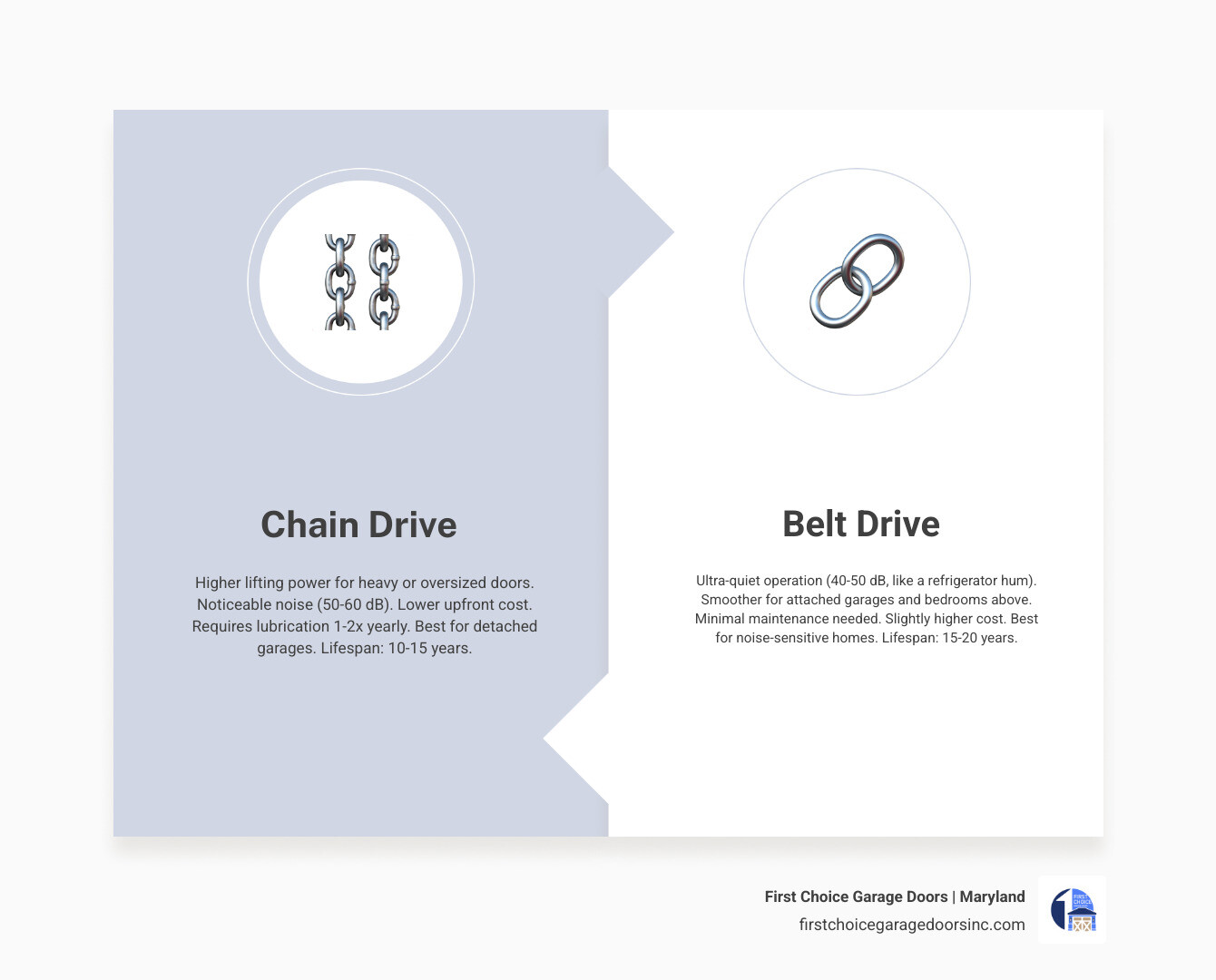
Here is a quick side-by-side to help you decide fast:
| Feature | Chain Drive | Belt Drive |
|---|---|---|
| Noise Level | 50-60 dB (noticeable) | 40-50 dB (refrigerator hum) |
| Lifting Power | Higher — great for heavy doors | Moderate — best for standard doors |
| Upfront Cost | Lower | Slightly higher |
| Maintenance | Lubrication 1-2x per year | Minimal |
| Best For | Detached garages, heavy doors | Attached garages, noise-sensitive homes |
| Lifespan | 10-15 years | 15-20 years |
The short answer: choose a chain drive if you have a heavy or oversized door and a detached garage. Choose a belt drive if your garage is attached to your home, shares walls with living spaces, or sits below a bedroom.
But the right choice really depends on your specific home layout, door weight, and how much noise matters to your household. The sections below break it all down clearly.
Comparing the Mechanics: Chain Drive vs Belt Drive Garage Door Opener

To understand which system is better for your home in Columbia or Frederick, we first need to look at how they move. Both systems are “trolley-style” openers. This means a motor sits in a box on the ceiling and moves a trolley back and forth along a rail to pull the door up or push it down. The main difference is the “drive” — the part that actually connects the motor to the trolley.
How Chain Drives Work
A chain drive uses a metal chain, very similar to a bicycle chain, to pull the trolley. This chain loops around a sprocket on the motor and runs the length of the rail. Because it is made of interlocking metal links, it is incredibly strong. However, metal-on-metal contact is naturally noisy. As the chain moves, it can rattle, clank, and vibrate against the rail. You can learn more about this and other options in our guide on the 3 Types of Garage Door Openers.
How Belt Drives Work
A belt drive replaces that metal chain with a reinforced rubber, fiberglass, or polyurethane belt. These belts are often reinforced internally with steel or fiberglass for strength, but the outer surface is smooth. Instead of clinking metal links, you have a flexible belt sliding quietly along the rail. This setup eliminates the “chatter” associated with chains, resulting in a much smoother movement.
Noise Levels and Operational Smoothness
In garage door openers, noise is measured in decibels (dB). For many of our neighbors in Maryland, the sound of the garage door is the “alarm clock” they never asked for.
- Chain Drives: These typically operate between 60 and 80 decibels. For context, that is about as loud as a vacuum cleaner or a busy restaurant. The noise comes from the chain vibrating and the metal links hitting the sprocket.
- Belt Drives: These are the gold standard for quiet operation. Some models operate as low as 33 to 40 decibels, which is comparable to a whisper or the hum of a modern refrigerator.
If you are looking for the ultimate in quiet technology, we often recommend products like the Secure View Ultra-Quiet Belt Drive Smart Opener Product, which combines silent operation with modern safety features like integrated cameras.
Why a belt drive garage door opener is the quietest choice for Maryland homes
If your garage is attached to your house, the chain drive vs belt drive garage door opener debate usually ends with the belt drive winning. In many Maryland home designs—especially in newer developments in Columbia and Frederick—bedrooms are located directly above or adjacent to the garage.
A chain drive doesn’t just make noise; it creates vibration. That vibration travels through the mounting brackets, into the ceiling joists, and right into the floorboards of the room above. A belt drive absorbs much of this energy, making it the preferred choice for families with light sleepers, infants, or shift workers who need to come and go without waking the whole house. You can explore these quiet options further in our Belt Drive Product Category.
Strength, Durability, and Lifting Capacity
While belt drives win on noise, chain drives are the “workhorses” of the industry. When it comes to raw lifting power and tensile strength, a steel chain is hard to beat.
Chain drives are often the better choice for:
- Solid Wood Doors: These can be incredibly heavy and require a lot of force to move.
- Oversized RV Doors: Large, tall doors found in workshops or specialized garages.
- Carriage-Style Steel Doors: Heavily insulated steel doors with decorative overlays can weigh significantly more than a standard aluminum door.
If you have a heavy door, a chain drive ensures the mechanism won’t slip or stretch under the weight. You can browse our strongest models in the Chain Drive Product Category. To ensure any system you choose lasts as long as possible, check out our tips on How to Increase the Longevity of Your Garage Door Opener.
Maintaining your chain drive vs belt drive garage door opener for long-term use
Maintenance requirements vary significantly between the two.
Chain Drive Maintenance: Because it is metal-on-metal, a chain drive requires regular lubrication. We recommend applying a high-quality garage door lubricant to the chain and sprocket at least twice a year. This prevents rust and reduces that “grinding” noise. Additionally, chains can stretch slightly over time, requiring a quick tension adjustment to keep them from drooping.
Belt Drive Maintenance: Belt drives are virtually maintenance-free. The belts do not require lubrication (in fact, putting oil on a rubber belt can actually damage it). You simply need to check the tension occasionally to ensure it hasn’t become too loose. For a complete look at keeping your system running, visit our Garage Door Openers Products and Services page.
Choosing the Right System for Your Maryland Home
When deciding between a chain drive vs belt drive garage door opener, consider the specific environment of your Maryland home. Our local climate features high humidity in the summer and freezing temperatures in the winter, both of which can affect opener performance.
| Consideration | Chain Drive | Belt Drive |
|---|---|---|
| Garage Location | Best for detached garages. | Best for attached garages. |
| Climate | Excellent in all Maryland weather. | Can occasionally slip in extreme humidity. |
| Door Material | Best for wood, glass, or heavy steel. | Best for aluminum or uninsulated steel. |
| Maintenance | Requires semi-annual lubrication. | Minimal maintenance needed. |
| Operation | Can be slightly “choppy.” | Very smooth start and stop. |
In Maryland, a detached garage or a workshop in Easton might be the perfect place for a rugged chain drive. However, for a suburban home in Columbia with a nursery above the garage, the belt drive is almost always the better investment. For more help narrowing down your choice, read about the Factors to Consider When You Pick Your Garage Door Opener.
Frequently Asked Questions about Garage Door Drives
Which is better for heavy oversized doors?
For exceptionally heavy doors, the chain drive is generally superior. Steel chains have higher tensile strength and are less likely to slip or break under extreme loads. If you have a two-car or three-car garage door made of solid wood, a high-horsepower chain drive is the safest bet. A great example of a modern, powerful unit is the DC Chain Drive Wi-Fi Garage Door Opener Product, which offers the strength of a chain with the smart features of a modern system.
How long do these openers typically last?
On average, a belt drive opener will last between 15 and 20 years. They have fewer moving parts and experience less friction than chain systems. Chain drive openers typically last between 10 and 15 years. However, with meticulous maintenance and regular lubrication, a chain drive can easily reach the 20-year mark. The choice often comes down to whether you prefer a longer “set it and forget it” lifespan or a lower-cost system that needs a little TLC. For a deeper dive into this comparison, see our article: Should You Get a Belt or Chain Garage Door Opener?
Can I convert a chain drive to a belt drive?
Yes, it is possible! Many homeowners who are tired of the noise from an old chain drive choose to convert. However, it isn’t always as simple as swapping the chain for a belt. Often, the entire rail and sprocket assembly must be replaced because the gears for a chain are different than those for a belt. We have created a Converting Chain Drive Garage Door Opener to Belt Drive: A Step-by-Step Guide to help you understand the process.
Conclusion
Choosing between a chain drive vs belt drive garage door opener doesn’t have to be a headache. If you value silence and low maintenance, the belt drive is your winner. If you need raw power for a heavy door and want to save on upfront costs, the chain drive is the “workhorse” you need.
At First Choice Garage Doors, we specialize in helping Maryland homeowners in Columbia, Frederick, and Easton find the perfect balance of performance and value. Whether you need a quick repair for a clanking chain or a brand-new, whisper-quiet belt installation, our experienced professionals are here to help.
Ready to upgrade your home’s entryway? Explore our full Garage Door Openers Category or contact us today for expert advice tailored to your Maryland home.